Before You Buy Lighting for Your Home, Event, or Business — Read This First
You know the regular run-around when sourcing a light fitting for your space — comparing suppliers, asking for quotes, scrolling through Instagram pages. The search never really ends, and somewhere in all that running around, everything starts to blur into one: same products, same photos, same price points, even the same words. “Premium.” “Quality.” “Luxury.” Everybody says it.
We’ve all been there. This guide shows you step-by-step how to tell what’s actually worth your money — so you’re not buying on guesswork or vibes alone.
The first thing to get clear on: what is the light actually for?
This seems obvious, but it’s the question most buyers skip. They see a chandelier they love and buy it. Then it arrives and it’s either too large or too small. The colour temperature is wrong. The fitting doesn’t work with their ceiling. The dimmer they bought isn’t compatible.
Before you speak to a supplier, be clear on:
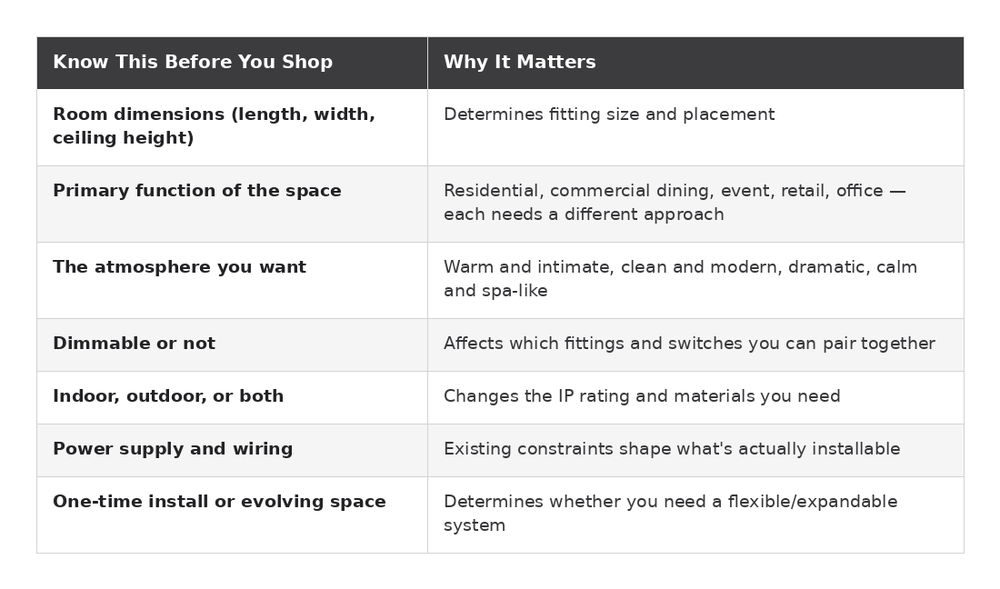
A lighting supplier who doesn’t ask you these questions before quoting you doesn’t understand lighting. They understand inventory.
Second: Know the Difference Between Decorative and Functional
Many buyers — especially for residential and event use — prioritize how a fitting looks over how it performs. This is natural. But a beautiful chandelier that throws unflattering light, or a pendant that looks stunning in a showroom but creates glare at dining height, or an outdoor fitting that corrodes after one rainy season, is not a good purchase at any price.
The questions to ask about any fitting:
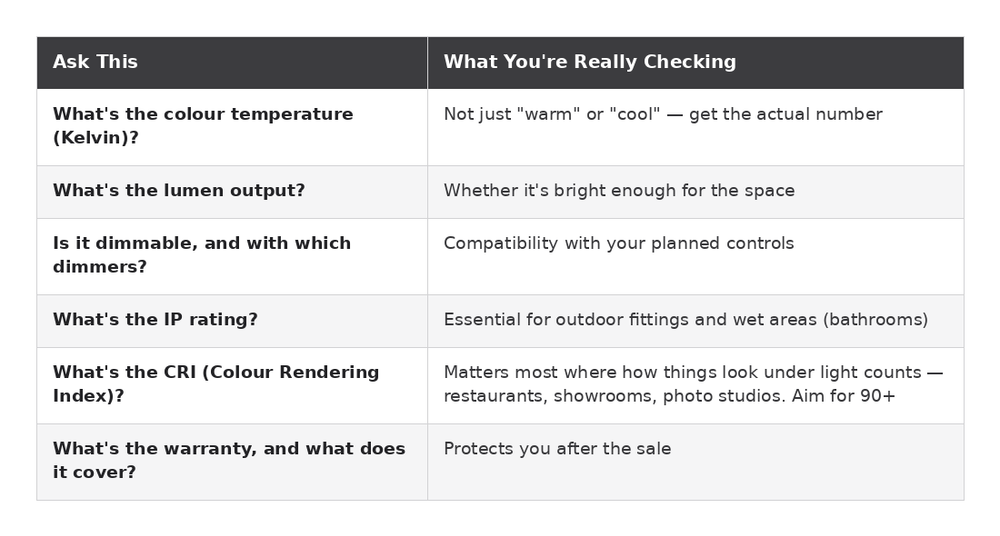
A supplier who can answer all of these fluently is a supplier who actually understands what they’re selling.
Think in Systems, Not Individual Fittings
A beautiful chandelier won’t save a room if nothing else around it is working with it. The spaces that feel truly considered — a restaurant, a living room, an event hall — aren’t built from one or two standout pieces. They’re built from a system: several different types of light, placed at different heights, working together on different switches, so the room can shift from bright and functional to warm and relaxed depending on what’s happening in it.
This is also where most buying goes wrong. People buy fittings one at a time — a chandelier here, a wall light there — without a plan connecting them. The result: pieces that are each beautiful on their own, but together feel mismatched. Warm light next to cool light. A huge pendant next to a tiny wall sconce. No single switch that makes sense.
Before you finalize your budget, make sure you can answer what each part of your system is doing:
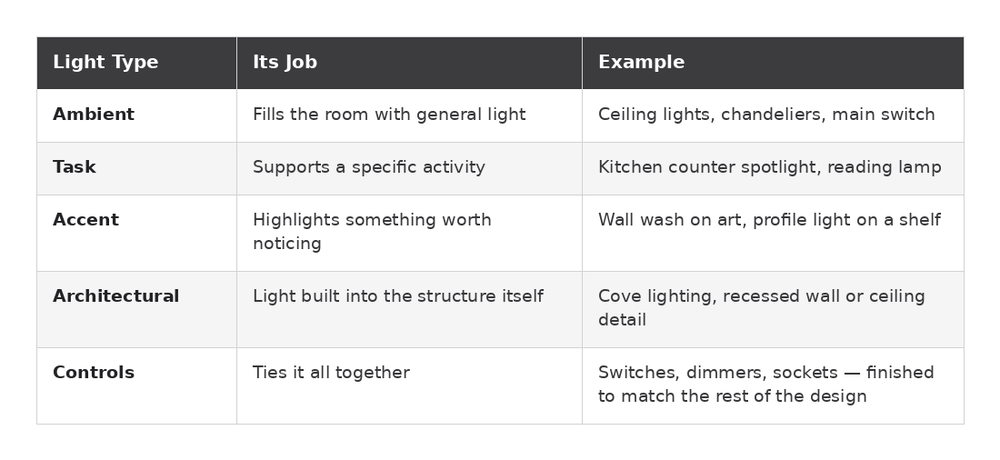
If you can’t fill in that table for your own space, you don’t have a lighting plan yet. You have a list of fittings.
Evaluate the Supplier, Not Just the Product
Lighting is not a commodity purchase. The product you buy is one part of what you need. What you also need is: someone who can help you figure out whether the product is right for your specific application, someone who will be there if something goes wrong, someone whose advice you can trust when you’re unsure.
The signals that a lighting supplier is worth working with:
- They ask questions before quoting. They want to understand your space, your goals, your timeline.
- They can speak to technical specifications — not just describe how things look, but explain how they perform.
- They cover both decorative and functional categories — a supplier who only sells beautiful statement pieces can’t help you solve the complete problem.
- They have relationships beyond just selling — can they advise on installation, or assist with specification if you’re working with an architect or designer?
- They have a track record — can they show you spaces they’ve contributed to, or point you to clients willing to vouch for them?
What a Considered Purchase Looks Like
When someone works through a thoughtful lighting brief — understanding the space, selecting the right systems, choosing fittings that work together with appropriate colour temperature and output — the result is visible from the moment the lights go on. The room feels finished. The event feels produced. The restaurant feels like it was designed to make people want to stay.
That feeling is not accidental. It’s what happens when the purchase is made with understanding rather than impulse.
Take the time to get it right. Ask the questions. Demand the answers. Choose suppliers who treat your space with the seriousness it deserves.
The light you put in a space will outlast almost every other decision you make about it. Make it carefully.