
The Complete Guide to Choosing the Right Light for Every Room and Every Moment
Most people buy lighting the wrong way.
They walk into a store (or scroll through an Instagram page) and pick the fitting that looks beautiful in isolation — the chandelier that photographs well, the pendant that matches the colour of a wall — and then wonder why the room still doesn't feel right once it's installed.
Light is not decoration. It's infrastructure. Choosing it correctly is less like picking a painting and more like designing a plumbing system: the individual pieces matter less than how they work together, where they go, and what they're asked to do.
This guide is for anyone who wants to stop guessing and start deciding. Whether you're fitting out a new home, renovating a single room, or trying to fix a space that has never felt quite right, what follows will give you a framework for thinking about light the way the people who design beautiful spaces do.
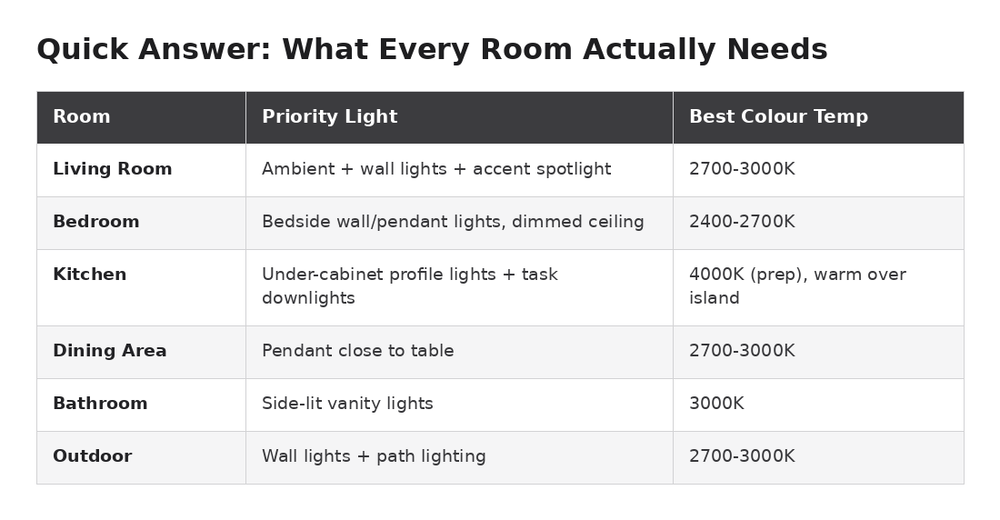
Quick Answer: What Every Room Actually Needs
Start With Function, Then Layer In Atmosphere
Every space has primary activities. A kitchen has cooking and eating. A living room has conversation, television, relaxation. A bedroom has rest, reading, getting dressed. A home office has focused work. A bathroom has grooming.
Your first question for any room should be: what does the light need to do? Not look like — do.
Once you've answered that, you layer. Task lighting for function. Accent lighting for atmosphere. Ambient lighting as the base that holds everything else together.
Room by Room
Living Room
This is the hardest room to light because it has the most competing demands. In the same space and sometimes at the same time: conversation, reading, watching television, hosting guests, relaxing alone.
The answer is not one light that tries to do everything. It's control.
A primary ambient source — typically a chandelier or a large pendant at the centre, or recessed downlights in a grid — handles general illumination. Profile lighting in a cornice or ceiling detail can provide warm, indirect fill light that softens the space without glare. Wall-mounted fittings at seating height add warmth and bring light down from the ceiling to the human level. A spotlight or two can be trained on artwork, shelves, or architectural features worth drawing attention to.
The key principle: every source should be on its own switch, or ideally a dimmer. When hosting, you want ambient low and wall lights on. When reading, you want the lamp close to the chair bright and everything else soft. When watching a screen, you want nothing competing with it from the front but something warm and low behind it.
Bedroom
The bedroom should have almost no overhead light in use during the hours before sleep. Overhead light suppresses melatonin. It also makes beds look institutional rather than inviting.
The ideal bedroom lighting system: a statement ceiling fitting (chandelier or pendant) that's on a deep dimmer and used only for initial orientation when you enter the room. Then: bedside wall lights or pendant droplights on either side of the bed, so each person can control their own. Then: a floor-level accent if there's space, or profile lighting built into the base of a feature headboard wall.
Colour temperature matters enormously here. The bedroom should never have cool-white or daylight LEDs. Warm white — 2700K — is the standard. Very warm — 2400K — is even better. The room should feel like candlelight when all the mains are dimmed and the bedside lights are on.
Kitchen
This is the one room where function genuinely leads and atmosphere follows.
Downlights or spotlights above the cooking and preparation areas are essential — they need to be bright enough to work safely, positioned so the cook's body doesn't cast shadow on their own workspace. Under-cabinet profile lights, installed in the plinth of the upper cabinetry, are the single highest-impact kitchen lighting upgrade available: they eliminate shadow entirely at counter level, making food preparation dramatically easier and the space dramatically more photogenic.
Over the island or dining extension, pendants or a row of droplights bring the light source down to the food level and create the warm, focused atmosphere that makes a kitchen feel like a destination rather than a utility room.
Dining Room or Dining Area
One rule: the light source should be as close to the table as possible.
A chandelier or pendant hanging at the right height above a dining table — typically around 70–80cm above the table surface — makes everything on the table look better. Food, drinks, faces. The food looks richer. The faces look warmer. The conversation slows down because the environment is literally designed for it.
Colour temperature: warm. Always warm. 2700–3000K. A cool dining light makes food look less appetizing — there's decades of food science research on this.
Bathroom
Most bathrooms have one central overhead light and nothing else. This is why most bathrooms feel like changing rooms.
The primary improvement is vanity lighting — light positioned at the sides of the mirror, not above it. Overhead mirror lighting creates shadows under the eyes, nose, and chin that distort what you see. Side-lit mirrors eliminate those shadows. This is how every professional makeup studio and film set is lit, and it works the same way at home.
A warm-toned wall fitting on either side of the mirror, at roughly eye height, transforms the grooming experience. Add a separate, dimmable ambient source and a waterproof profile light at floor level for night use, and you have a bathroom that feels like a spa.
Outdoor Spaces
Outdoor lighting often gets the least thought and delivers some of the most visual impact because the contrast with darkness is so stark.
Outdoor wall lights on the facade of a building set the tone for everything inside. They define the approach, communicate the character of the space before anyone enters, and create the warm exterior glow that photographs as "the beautiful home" in every real estate image.
Path and garden lighting (bollard lights, recessed ground lights, low-mounted outdoor fittings) create safety and atmosphere together — guiding movement while layering warmth across the landscape.
If you have a terrace, courtyard, or external entertaining space, outdoor overhead fittings create the same psychological warmth as indoor ones. People are more comfortable, more willing to stay, more likely to enjoy themselves when the outdoor space feels lit with intention rather than exposed to darkness or brutal security lighting.
Colour Temperature: The Decision Most People Get Wrong
Light colour is measured in Kelvins. The lower the number, the warmer the light. Higher numbers move toward cool blue-white.
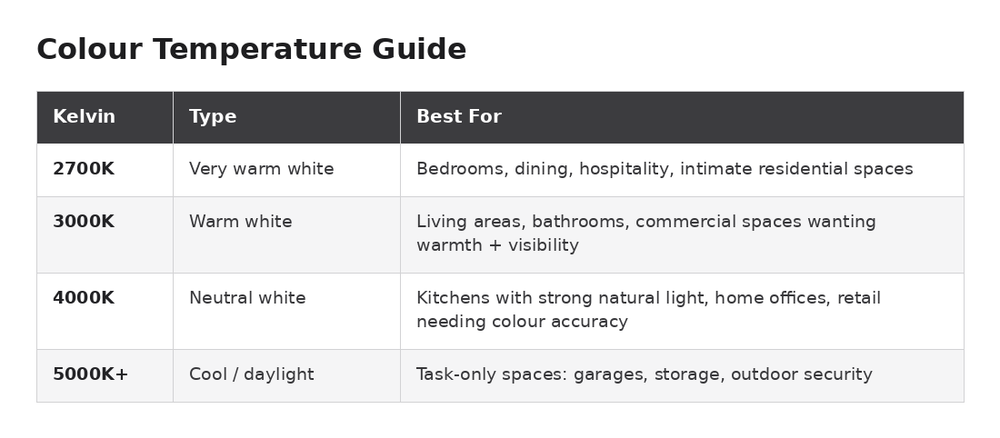
Most homes in Nigeria are over-lit with 6000K cool white LEDs that create a clinical, draining atmosphere in spaces designed for rest and connection. This single mistake — choosing the wrong colour temperature — is responsible for more "my home doesn't feel right" searches than almost any other factor.
Dimmers: The Most Underrated Lighting Tool
Every light in your home should ideally be dimmable. Not because you want to dim everything, but because the ability to shift a room from 100% to 40% transforms what the space can do. A room at 40% in the evening becomes a different experience entirely — warmer, softer, more alive — than the same room at full brightness.
Dimmer-compatible switches exist for a reason. Use them.
Switches and Controls: Where Design Meets Daily Life
A beautifully fitted room with a cheap plastic switch feels incomplete in a way that's hard to articulate. The switch is touched multiple times a day. It's the interface between the person and the light. It deserves the same consideration as any other surface in the room.
Switches and sockets in brushed brass, matte black, or polished chrome bring a room together at the details level. They're small things that signal: this space was considered all the way down to its smallest elements.