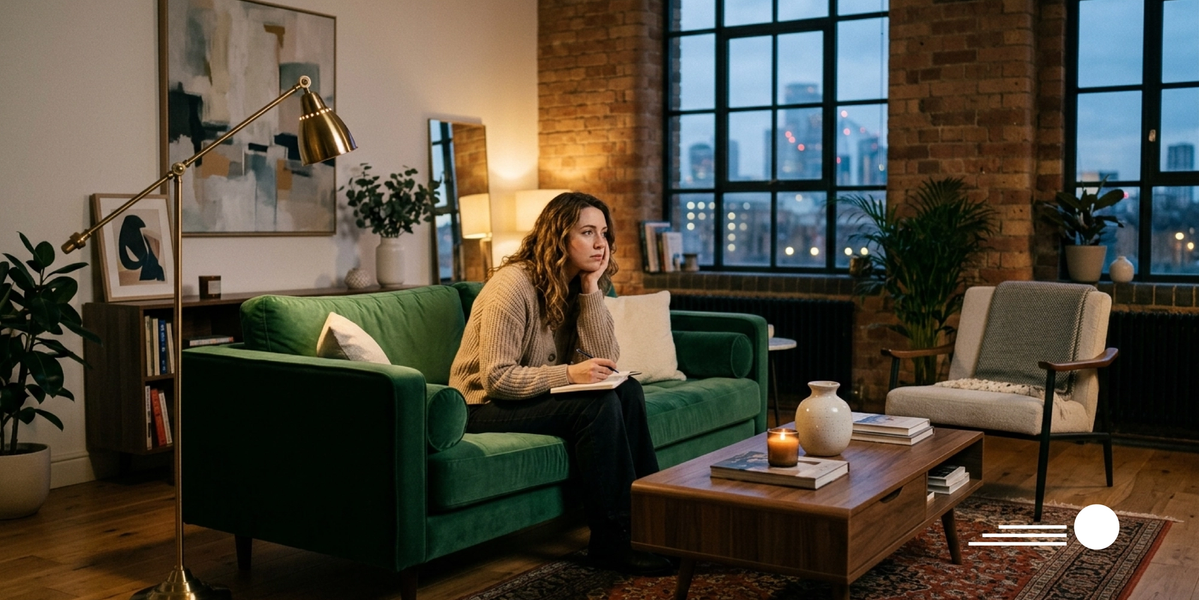
You've done everything right.
The sofa is from a brand people recognize. The artwork cost more than a semester of university. You had a mood board — actually had a mood board and you followed it. The rug ties the room together. Every piece is intentional.
And yet.
You walk into that room and something feels... flat. Like a photograph of a beautiful place, not the place itself. You've had guests compliment the décor and still left feeling like the space wasn't quite done. You keep moving things around. A new throw pillow. A different plant. Another side table. The feeling doesn't shift.
You're not imagining it. The room genuinely isn't finished. But the thing that's missing isn't a piece of furniture — it's the thing that makes all the furniture visible in the first place.
The problem most people never consider is light.
Not lighting in the "do I have a bulb in the ceiling" sense. Light in the architectural sense — the way it falls on surfaces, wraps around edges, creates shadow and depth, tells the eye where to go and where to rest.
Here's what's happening in spaces that feel flat: every surface is receiving the same amount of light. The ceiling, the wall, the floor, the sofa — all equally visible, all equally uninteresting. When everything is illuminated the same way, the eye doesn't know what to prioritize. The brain reads it as: nowhere to land. And that translates, emotionally, as emptiness.
Contrast this with the spaces that actually move you.
Think of a hotel lobby that stopped you at the entrance. Or a restaurant you'll describe for years. Or someone's home that felt like stepping into a different world. What those spaces share — underneath the marble and the custom joinery and the curated art — is deliberate, layered light.
What layered light actually means
Lighting designers talk about three layers. Most homes and commercial spaces achieve one. Great spaces achieve all three.
The first layer is ambient light — the general illumination that fills a room. Most people stop here and call it done. Overhead fittings, ceiling lights, the main switch. Done. But ambient-only lighting is like painting a canvas one flat colour. There's no story.
The second layer is task light — focused light that serves a purpose. A pendant above a dining table. A spotlight trained on a kitchen counter. A reading lamp angled at a chair. This layer creates intention in a room. It says: this is where things happen.
The third layer — the layer most spaces are missing entirely — is accent light. Light that exists not to illuminate function but to illuminate feeling. A slim profile light that grazes a textured wall and reveals its depth. An indoor wall fitting that washes warm light upward and makes the ceiling breathe. A downlight that pools on a coffee table just so, making the objects on it feel precious.
That third layer is the one that separates spaces that are pretty from spaces that are felt.
The psychology is not accidental
Human brains are wired for contrast. We find comfort in spaces where light and shadow coexist — it signals enclosure, safety, warmth. Spaces with only overhead, even lighting mimic the flat light of outdoors at noon: exposed, directionless, draining.
When a room has shadow, it has depth. When it has depth, it has interest. When it has interest, the people inside it relax.
This is why the most expensive-feeling hospitality spaces almost always have low, localized sources of light — not because it's a design trend but because it works on the nervous system. You settle in. You want to stay.
What this means for your space
Before you buy another piece of furniture, before you repaint the walls, before you hire a stylist — look at your light sources.
Count them. Where are they? Are they all on the ceiling? Are they all controlled by one switch? What happens if you turn off the main light and use only the secondary ones? Is there a secondary source at all?
The rooms that feel complete almost always have at least one light source at eye level or below. Something that doesn't flood the room but defines a corner of it. Possibly a wall fitting that creates a warm bloom on a surface you want people to notice. Possibly a pendant that descends into the center of a table and makes the table feel like the center of the world.
Profile lighting — linear light built into the architecture of a wall or ceiling — is often what separates a renovation that looks "finished" from one that looks "designed." It's not decorative in the obvious sense. It doesn't announce itself. It just makes everything around it look considered.
Accent downlights, positioned deliberately, can transform a shelf of books from storage into an installation. A simple alcove becomes a destination. A wall becomes a canvas.
The question to ask yourself
Stand in the middle of your space in the evening with only your overhead lights on.
Now close your eyes and imagine the warmest, most beautiful room you've ever been in. The temperature of the light. The way certain things glowed and others receded. The feeling of being held by the space.
Open your eyes.
That gap you're feeling right now — that's a lighting problem. And unlike a new sofa, it has a permanent solution.